
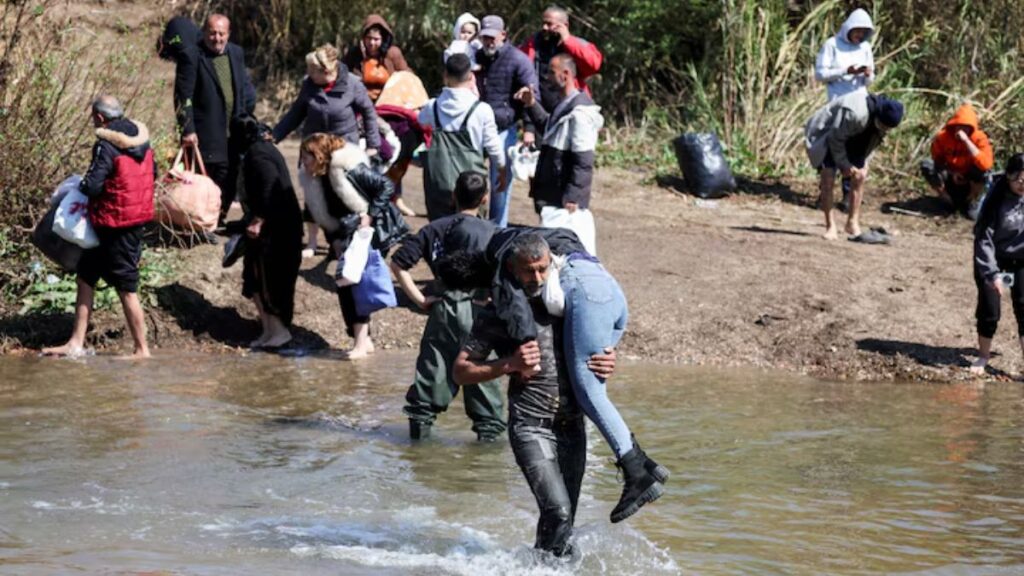

More than one Syrian citizen from minority communities spoke about their struggle to obtain approval for asylum applications submitted to several European Union countries, without success, according to a report published by Reuters on Wednesday, April 22.
Mohammad, a student from the Alawite community and originally from Jableh (Latakia countryside), said his family left their home after the events of March 2025 in a state of terror because of the ordeal and the wave of killings that targeted Alawites, according to his account.
He explained that he traveled to the Dutch capital, Amsterdam, on a tourist visa with his uncle Salman, nine months after the incident, seeking asylum in the European country.
Mohammad said their application was rejected within weeks because they were not considered to be personally at risk, according to documents reviewed by Reuters.
In another case, Rana Izoli, a Syrian Kurd, recounted how she fled the fighting in northeastern Syria in 2023 with her daughter, now 11, to Germany, where she applied for asylum in April 2024.
She said Germany’s Federal Office for Migration and Refugees, BAMF, rejected her application in December 2025, saying reports were insufficient on how the new government deals with Kurdish men and women, and that her area remained under Kurdish administration.
Imad Obeid, an artist from Suwayda (southern Syria), who left Syria in 2012 and arrived in the Netherlands in 2023, said the asylum application he submitted in February 2024 was frozen by the Dutch government.
He said the Immigration and Naturalisation Service justified freezing the decision by saying Druze are not considered a group at risk, unlike Alawites, and that Obeid had not proved he would be at risk if he returned.
Most Asylum Applications Rejected
Reuters documented that most asylum applications by Syrian minorities were rejected in Europe, even though they obtained asylum at higher rates than Syrians overall in Germany last year. The success rate reached 20% for Alawites, 9.1% for Druze, and 11.8% for Kurds.
Germany’s Interior Ministry declined to comment on the rejection rates, saying the Federal Office for Migration and Refugees had resumed interviews with Syrian asylum seekers.
Britain’s Home Office said it had resumed processing Syrian asylum applications, with decisions taken on a case-by-case basis, while the interior ministries in France and the Netherlands did not respond to requests for comment.
A spokesperson for the French asylum agency, OFPRA, said about 85% of Syrian asylum seekers received protection in 2025.
The Dutch Immigration and Naturalisation Service declined to comment on individual cases, and a spokesperson said 7% of Syrian asylum seekers received protection in 2025.
The agency documented 18 rejected asylum cases involving individuals or families from Syrian minorities, based on interviews with asylum seekers and lawyers, and a review of decision files and claims in Britain, France, Germany, and the Netherlands submitted by Syrians from Alawite, Druze, Kurdish, Christian, and Shiite minorities.
Against those rejections, Reuters said one person from the Alawite community succeeded in obtaining protection in the Netherlands, while one Christian received similar approval in France.
No Discrimination Between Components of Society
Syria’s Ministry of Information told Reuters that the government is firmly committed to protecting all Syrian communities and does not tolerate attacks against civilians.
The ministry rejected allegations of sectarian discrimination, including in education, although it acknowledged violations committed by state-affiliated individuals in Suwayda, in the context of long-standing local tensions and external interventions.
It stressed that the government is working to place all forces under unified control, adding that officers responsible for violations will be held accountable.
Thousands of Applications Rejected
The European Union Agency for Asylum issued negative decisions on 27,687 asylum applications out of 38,407 in 2025, explaining that this was often due to procedural steps, such as asylum seekers having previously applied in another EU country, or withdrawing their applications.
That represented an acceptance rate of 28%, compared with 90% in 2024.
Reuters said the first instance acceptance rate also fell across the European Union, Norway, and Switzerland for all nationalities, to 29% in 2025 from 42%, mainly because of a sharp drop in the number of decisions related to Syrian applications.
In February 2026, 19% of applications submitted by Syrians were accepted.
European Commissioner Magnus Brunner told Reuters that the situation in Syria remains “very difficult,” and that all asylum applications are examined individually, adding that decisions are not random but based on assessments of each case separately.
The agency said most of the cases it documented were rejected because there was no evidence or detail about the person’s circumstances indicating they would be personally at risk, or because the accounts were too general or inconsistent, or because the applicants came from an area not affected by violence targeting their religious group.
Despite the rise in rejected applications, Reuters noted that the latest Dutch asylum policy on Syria, which takes precedence over guidance from the European asylum authority, said that Alawite minorities, gay people, and transgender people are at risk in Syria.